
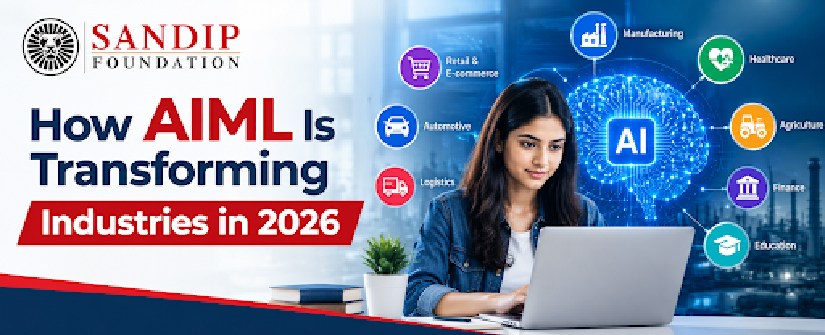
Artificial Intelligence and Machine Learning (AIML) is one of the crucial technologies of the upcoming industries. Intelligent machines are no longer restricted to science fiction concepts or research labs based in some of the best computer science colleges in Nashik in 2026. Today, they are increasingly playing a significant role in health care, finance, manufacturing, education, retail and other industries.
AIML is designed to help machines learn and make intelligent decisions by recognising patterns and solving complex problems from the data. Unlike traditional computer programs which only execute predetermined instructions, today’s AI systems can adapt themselves to better perform over time. This capability has turned intelligent machines into effective tools for businesses, researchers, and entities across the globe.
AIML is ushering in a new digital revolution where humans and machines collaborate for increased efficiency, precision, and innovation.
Understanding AIML and Intelligent Machines
Artificial Intelligence (AI) & Machine Learning (ML) is a combination of AIML. AI is all about building machines that can do things that a human can, but things that require reasoning, decision making and problem solving. The ability to learn, or adapt the results, from vast quantities of data without ongoing human programming, is why these systems are called Machine Learning.
A system that uses fixed rules can identify fraud in a traditional software; a machine learning system on the other hand can review millions of transactions and can automatically detect unusual patterns to identify fraud. This provides greater flexibility and effectiveness of AI systems.
Advanced technologies such as deep learning, NLP, computer vision and generative AI are driving the enhancement of smart machines in 2026. These enable computers to interpret people’s speech, identify images, generate text, and aid in making complex decisions.
How AIML is Transforming Major Industries
1. Healthcare: Smarter Diagnosis and Better Treatment
AIML is transforming healthcare as one of the sectors. Medical institutions like hospitals and research bodies generate vast quantities of data, such as patient records, medical images, and research data. AI systems can analyse this data quickly and provide valuable insights to healthcare professionals.
Doctors are aided by machine learning algorithms that are detecting diseases at an earlier stage by analysing reports, such as medical X-rays, CT scans and even MRI images. AI can identify patterns that humans may not be able to see, resulting in improved diagnoses.
AIML is also making contributions in the field of personalised medicine. Instead of a ‘one size fits all’ approach, AI can analyse patient-specific data and make unique treatment recommendations. This enables doctors to deliver better and patient cantered care.
2. Manufacturing: The Development of Smart Factories
Manufacturing is heading towards smart factories with AIML, Robotics, and Automation. Intelligent machines are enhancing the quality, efficiency and reducing costs of business production.
One of the major advantages of AIML in the manufacturing sector is predictive maintenance. With the help of AI, a computer system can identify the machines, their performance, and anticipate any problem that might occur. This way, there is less downtime and the likelihood of expensive equipment damage is reduced.
Machine learning has also been instrumental to the advancement of modern robots. AI-powered robots can adjust to new conditions and collaborate with people, in contrast to traditional robots which execute only pre-programmed tasks. Human skills and machine intelligence are jointly making industrial environments more productive.
3. Finance: Improving Security and Customer Experience
AIML has increasingly become a key player in the financial sector to enhance banking services and customer protection.AIML is being increasingly implemented in the financial sector to boost banking services and shield customers. AI can be a valuable tool for banks to process millions of transactions daily and gain insights into financial activities.
The machine learning models are able to identify suspicious transactions and mitigate fraud. This enhances security and decreases financial risks for companies and customers.
Virtual assistants are another example of how artificial intelligence (AI) is revolutionising the banking experience. Intelligent chat systems enable customers to get rapid replies, tailored suggestions, and help. In the investment and financial planning sector, AIML aids in the analysis of market trends and making informed decisions.
4. Retail: Personalised Shopping Experiences
In the retail sector, AIML is used to gain insights into customer behaviour, improving the overall shopping experience. AIML is also being applied in retail to gain insights into customer behaviour, improving their shopping experience. Another application of machine learning is in personalising the customer experience, which can in turn be used for suggesting products to customers based on their past behaviour and preferences.
Recommendations can lead customers to products that they would want to purchase and thus help businesses generate sales and increase customer satisfaction. AIML can be used as an inventory management system that would help businesses foresee the future demands of their customers and stock up accordingly.
AI technology has changed the retail sector by making it more efficient and customer-oriented by professionals holding a B.Tech in Artificial Intelligence and Machine Learning qualification.
5. Education: Creating Smarter Learning Systems
AIML is also making a major contribution to the field of education. Another key area where AIML is making an impact is in education. The methods used in traditional education may be universal but with the help of AI, one can have a personalised approach for a diverse group of students.
With the help of AI-based learning platforms, these systems are able to study the performance of students and provide individual lesson recommendations. Students can use virtual AI assistants to learn and receive support with their ideas, questions and more even out of class.
AIML is also facilitating institutions to educate students for future jobs by integrating AI skills and promoting tech-enabled learning.
Generative AI and the Future of Intelligent Machines
Generative AI and the rise of intelligent AI agents is one of the largest advancements in AIML. Generative AI can produce text, images, software code and other digital material. AI agents can execute tasks, information analysis, and assist the business.
These technologies are helping to boost productivity and automate repetitive tasks for organisations. AI assistants can aid in data analysis, customer service, research, content creation, among other tasks. It’s not a matter of replacing humans with machines but about humans collaborating with machines.
Benefits and Challenges of AIML
AIML offers a number of benefits, such as:
- More efficient resource management and usage
- Better productivity by automation
- Better customer experiences
- Reduced operational costs
- Efficient data analysis
But AIML poses problems as well. The problem of data privacy, cyber security, and ethical issues is a crucial one. With the development of AI systems, there is a need for a huge amount of data.
Job transformation is another worry. AI will not just make processes easier but also provide new opportunities, such as artificial intelligence, data science, robotics, and technology management.
Conclusion
By 2026 the intelligent machines are rapidly converging with the world, producing smarter, faster and more efficient industries. AIML is now a potent technology that can help innovation in fields ranging from healthcare to manufacturing, finance to retail, and education.
It is the human-to-human interaction with machines, which will be the key to the success of AIML for professionals holding qualifications from some of the top computer engineering colleges in Maharashtra. Human creativity and machine intelligence can achieve solutions of complex problems and new opportunities for organisations. AIML is still under development, and intelligent machines will be an important part of the digital world.